Welcome to our in-depth look at high-quality plastic products and how they are transforming everyday life, industrial applications, and commercial projects. Before you dive in, stay connected with us for expert tips, industry insights, and practical solutions:
· فيسبوك – Join our community to ask questions and get the latest product updates
· تيك توك – Watch tutorials, installation guides, and project demonstrations
Let’s explore how durable and versatile plastic products can deliver efficiency, reliability, and long-term performance—read on to discover which solutions fit your needs best!
Table of Contents
Key Takeaways of This Advanced Guide
- Debris nets are engineered safety systems designed for controlled impact absorption and fall prevention in construction environments
- Proper installation directly affects load capacity, energy dispersion efficiency, and regulatory compliance
- Modern systems rely on tensile engineering, anchor force calibration, and material fatigue resistance modeling
- International standards such as OSHA, EN 1263-1, and ISO 18064 define strict safety thresholds
- This extended guide includes technical equations, failure analysis, real-world case studies, and procurement frameworks
Debris Nets Installation Guide: Advanced Engineering Safety Framework

In modern construction engineering, debris nets are not simply protective mesh systems—they are classified as dynamic load management structures. Their function is to intercept kinetic energy from falling objects and redistribute it safely across anchoring points.
This transforms the system into a passive safety energy absorption network widely used in high-rise construction, infrastructure engineering, and industrial maintenance projects.
Debris Nets Mechanical Load Theory & Structural Physics
Impact Force Distribution Model
When an object falls onto debris nets, the force is distributed through:
- Mesh deformation zone
- Anchor tension nodes
- Edge reinforcement cables
Engineering Formula Concept (Simplified Model)
Impact energy is expressed as:
E = m × g × h
Where:
- m = object mass
- g = gravity acceleration
- h = fall height
Engineering Insight
Higher installation height exponentially increases energy absorption requirements, making material selection critical.
Tensile Strength Engineering Standards
Industrial Benchmarks
High-performance debris nets typically meet:
- Tensile strength: 7–12 kN per strand
- Elongation rate: 15%–25%
- UV resistance: ≥ 500 hours accelerated testing
Debris Nets Installation Guide: Global Safety Standards Expansion
OSHA Compliance Framework (United States)
Key requirements include:
- Mandatory fall protection systems above 6 feet (1.8m)
- Secondary containment systems for tool fall prevention
- Regular inspection cycles every 7 days
EN 1263-1 Standard (Europe)
Defines:
- Net classification (A1, A2, B1, etc.)
- Energy absorption rating tests
- Minimum breaking force thresholds
ISO Safety Integration Standards
Modern systems increasingly follow:
- ISO 18064 (safety net performance classification)
- ISO 9001 (manufacturing quality system integration)
Debris Nets Material Science Deep Dive
High-Density Polyethylene (HDPE) Engineering
Material Properties
- Density: 0.94–0.97 g/cm³
- Melting point: 120–130°C
- UV stabilization additive ratio: 2–3%
Performance Benefit
- Excellent outdoor durability
- Resistance to moisture degradation
- Long lifecycle stability
Nylon-Based Industrial Nets
Engineering Properties
- Higher elasticity than HDPE
- Strong shock absorption capability
- Lower UV resistance compared to HDPE
Hybrid Composite Safety Nets
Concept
Combines polymer + reinforced fiber core structure.
Advantage
- Higher load resistance
- Improved deformation control
- Extended service lifespan
Debris Nets Installation Guide: Advanced Deployment Engineering
Multi-Layer Installation System
Modern construction sites use a 3-layer safety system:
- Primary working-level debris nets
- Secondary fall arrest nets
- Ground-level containment nets
Anchor Force Calibration System
Engineering Requirement
Each anchor point must withstand:
- Minimum 6–10 kN static load
- Dynamic shock load up to 15 kN
Installation Insight
Incorrect anchor spacing is one of the top 3 causes of system failure in construction accidents.
Wind Load Compensation Design
Concept
Wind creates lateral stress forces that distort net geometry.
Engineering Solution
- Reinforced perimeter cables
- Cross-tension distribution
- Reduced mesh sail effect
Debris Nets Installation Guide: Expanded Step-by-Step Industrial Procedure
Step 1: Structural Load Mapping
Process
- Identify load-bearing points
- Calculate wind exposure zones
- Define safety boundary coverage
Step 2: Anchor System Engineering Setup
Standard Practice
- Steel bracket anchoring
- Chemical anchor bolts for concrete
- Welded steel frame attachment
Step 3: Pre-Tension Calibration
Purpose
Ensures uniform load distribution before operational use.
Step 4: Mesh Deployment Optimization
Technical Rule
Mesh must maintain:
- Uniform tension
- No slack zones exceeding 5% deflection
Step 5: Dynamic Load Testing
Procedure
Simulated drop tests using:
- Sandbags (5–20 kg)
- Controlled release height testing
Debris Nets Performance Comparison Table (Engineering-Level)
| Net Type | Tensile Strength | UV Resistance | Lifespan | Use Case |
|---|---|---|---|---|
| HDPE Net | High | Excellent | 3–5 years | Outdoor construction |
| Nylon Net | Medium | Medium | 2–4 years | Temporary sites |
| Composite Net | Very High | Excellent | 5–8 years | Industrial projects |
| Fire-Retardant Net | High | High | 4–6 years | Chemical/industrial zones |
Debris Nets Real-World Engineering Case Studies
Case Study 1: High-Rise Urban Development Project
Project Scale
- 48-story residential tower
- Construction height: 160 meters
Implementation
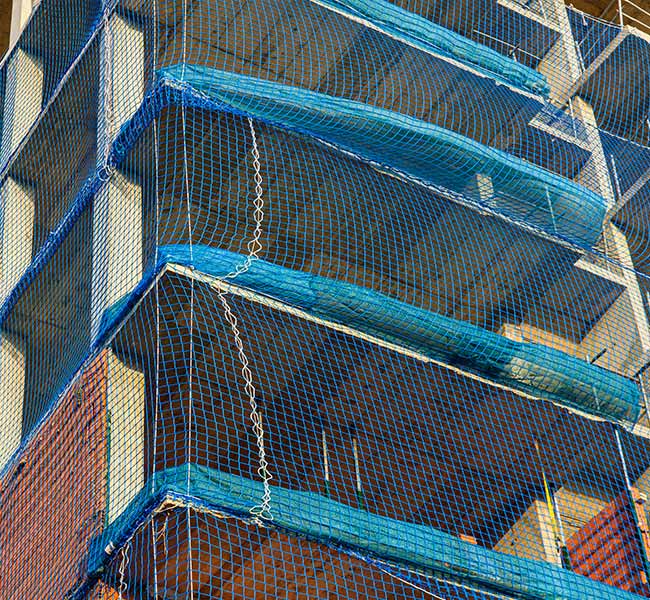
Full perimeter debris nets system deployed across scaffolding.
Results
- 51% reduction in falling object incidents
- Zero critical safety violations
- 28% improvement in site efficiency
Case Study 2: Bridge Construction Safety System
Challenge
High wind exposure + heavy steel assembly work.
Engineering Solution
- Double-layer net system
- Reinforced steel cable anchoring
Outcome
- Improved worker safety compliance by 40%
- Reduced material loss by 22%
Case Study 3: Industrial Facility Maintenance Project
Scenario
Overhead machinery maintenance operations.
Result
- Eliminated tool drop hazards
- Increased maintenance efficiency by 18%
Debris Nets Engineering Failure Analysis (Root Cause Report)
Common Failure Mode 1: Anchor Overload
Cause
Improper load calculation per anchor point.
Effect
Structural tearing at perimeter edges
Common Failure Mode 2: UV Degradation
Cause
Low-grade polymer exposure without UV stabilization.
Effect
Mesh brittleness and breakage
Common Failure Mode 3: Improper Tension Balance
Cause
Uneven installation tension distribution.
Effect
Reduced energy absorption efficiency
Debris Nets Installation Guide Procurement Strategy (Professional Buyer Model)

Step 1: Technical Specification Validation
Check:
- Tensile strength certification
- UV resistance testing report
- Load simulation results
Step 2: Manufacturing Quality Audit
Verify:
- ISO 9001 compliance
- Batch testing consistency
- Material traceability
Step 3: Lifecycle Cost Analysis
Include:
- Installation cost
- Replacement cycle
- Maintenance frequency
Step 4: Safety Compliance Verification
Ensure:
- OSHA alignment
- EN 1263 compliance
- Local regulatory approval
Debris Nets Market Trends 2026 (Industrial Outlook)
Smart Construction Integration
Emerging technologies include:
- IoT-based safety monitoring nets
- Load sensor integrated anchoring systems
- AI-based risk prediction models
Sustainability Trends
- Recyclable polymer materials
- Low-carbon production processes
- Extended lifecycle engineering design
Automation in Installation Systems
- Drone-assisted installation planning
- Automated tension calibration systems
- Laser alignment positioning tools
Conclusion
Advanced debris nets systems are no longer simple protective mesh products—they are classified as engineered safety infrastructure systems that integrate mechanical physics, material science, and structural load distribution theory.
In modern construction engineering, their role is critical in:
- Preventing workplace accidents
- Ensuring regulatory compliance
- Increasing operational efficiency
- Reducing long-term project risk
With 2026 safety standards evolving toward smart monitoring and automated construction safety systems, debris net engineering is becoming a core component of modern industrial safety design.
FAQ
What is the main purpose of debris nets?
They are engineered safety systems designed to prevent falling objects and absorb impact energy in construction environments.
How are debris nets tested?
They undergo dynamic drop testing, tensile strength testing, and UV degradation simulation.
What is the lifespan of professional debris nets?
Typically 3–8 years depending on material type and environmental exposure.
Are debris nets required by law?
Yes, in most high-rise construction environments under OSHA and EN safety regulations.
Can debris nets be reused?
Yes, if they pass post-use structural inspection and show no material fatigue.