Welcome to our in-depth look at high-quality plastic products and how they are transforming everyday life, industrial applications, and commercial projects. Before you dive in, stay connected with us for expert tips, industry insights, and practical solutions:
· Facebook – Join our community to ask questions and get the latest product updates
· Tiktok – Watch tutorials, installation guides, and project demonstrations
Let’s explore how durable and versatile plastic products can deliver efficiency, reliability, and long-term performance—read on to discover which solutions fit your needs best!
Table of Contents
Key takeaways
- HDPE sewer pipe size should be selected from peak design flow, not average daily flow alone.
- Outside diameter, inside diameter, wall thickness, SDR, slope, and pipe roughness all affect hydraulic capacity.
- A larger nominal diameter does not always provide the best lifecycle result.
- Gravity sewer and pressure sewer systems require different sizing methods.
- The pipe must carry peak flow while also maintaining acceptable performance during low-flow periods.
- Fittings, bends, manholes, changes in elevation, and connection methods can reduce effective system capacity.
- Hydraulic sizing must be supported by burial-depth, soil-load, deflection, flotation, and installation checks.
- Final pipe selection should comply with applicable municipal regulations and project engineering specifications.
Introduction
Selecting an HDPE sewer pipe is not simply a matter of choosing the next available diameter from a supplier’s catalog. A reliable sewer system must transport wastewater at the required flow rate, operate under changing demand, resist blockage, and remain structurally stable after burial.
The correct size depends on several connected variables:
- Average and peak wastewater flow
- Pipe inside diameter
- Pipeline slope
- Hydraulic roughness
- Expected solids content
- Infiltration and inflow
- Future development
- Burial conditions
- Connection and maintenance requirements
High-density polyethylene is widely used in underground pipeline systems because it is flexible, corrosion-resistant, chemically stable, and suitable for welded connections. These characteristics make HDPE sewer pipe useful for municipal sewage networks, industrial wastewater systems, highway drainage, building drainage, and underground infrastructure.
Zenlink’s plastic pipe product range includes pipe systems for drainage, water transportation, industrial wastewater discharge, and infrastructure applications. However, the product dimensions still need to be matched to the hydraulic and structural requirements of each individual project. The Zenlink product overview specifically identifies HDPE drainage pipes for highway drainage and corrosion-resistant HDPE systems for industrial wastewater discharge.
What Does HDPE Sewer Pipe Size Actually Mean?
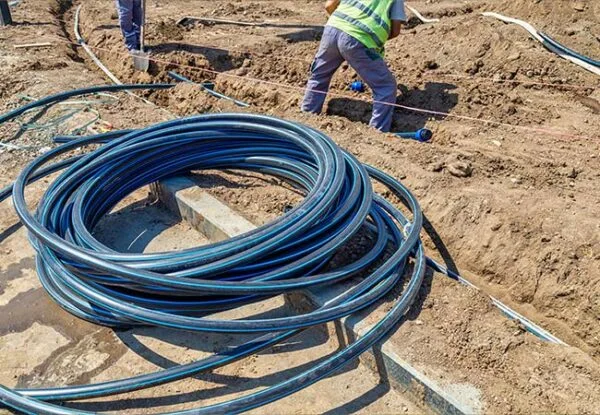
HDPE sewer pipe is often identified by nominal size or outside diameter. The outside diameter is important for manufacturing, fittings, fusion machines, and joint compatibility, but it is not the dimension that directly determines the available flow area.
Outside Diameter
Outside diameter, or OD, is the measurement across the external surface of the pipe. HDPE pipes and compatible fittings are commonly ordered and matched using this dimension.
For example, two pipes may both have an outside diameter of 315 mm but use different wall thicknesses. Although they appear to be the same nominal size, their inside diameters and hydraulic capacities may be different.
Inside Diameter
Inside diameter is the open internal space through which wastewater travels. It directly affects:
- Cross-sectional flow area
- Flow capacity
- Velocity
- Hydraulic radius
- Risk of solids accumulation
Why Inside Diameter Controls Flow
A thicker wall reduces the inside diameter. This means that selecting a lower SDR pipe for higher pressure resistance may also reduce the flow area when the outside diameter remains unchanged.
The related Zenlink guide on PE pipe sizes explains why pipe diameter, wall thickness, pressure rating, flow demand, and connection method should be evaluated together rather than treated as separate purchasing decisions.
Wall Thickness
Wall thickness affects the mechanical and pressure performance of an HDPE sewer pipe. It also changes the internal opening available for flow.
A thicker wall may be needed where a pipe is exposed to internal pressure, installation stress, unusual loading, or specific project standards. However, unnecessary wall thickness can increase material use while reducing the internal flow area.
SDR
SDR means standard dimension ratio. It describes the relationship between the outside diameter and wall thickness:
SDR = Outside Diameter ÷ Wall Thickness
A lower SDR indicates a thicker pipe wall. A higher SDR indicates a thinner wall relative to the outside diameter.
SDR Comparison Concept
For pipes with the same outside diameter:
- SDR 11 has a thicker wall and smaller inside diameter.
- SDR 17 has a thinner wall and larger inside diameter.
- SDR 21 has a still larger internal opening but lower pressure capacity than lower-SDR alternatives.
SDR should never be selected only to maximize flow. It must satisfy pressure, surge, handling, installation, and structural requirements.
Start HDPE Sewer Pipe Sizing with Design Flow
The first major input is the amount of wastewater the system must carry. Pipe size should be based on realistic design conditions rather than a rough estimate of the current average flow.
Average Daily Flow
Average daily flow represents typical wastewater production over a normal day. It helps planners understand the basic load placed on the sewer system.
However, average flow alone is rarely sufficient for selecting an HDPE sewer pipe because wastewater demand changes by hour, season, occupancy, and operating schedule.
Peak Flow
Peak flow is the maximum expected flow during a defined design condition. It may occur during:
- Morning or evening residential demand
- Factory production shifts
- Commercial operating hours
- Rainfall-related inflow
- Seasonal population increases
- Simultaneous equipment discharge
The HDPE sewer pipe must have enough capacity to carry the expected peak without causing unacceptable surcharge, backup, overflow, or excessive upstream water levels.
Peak-Factor Concept
A peak factor converts average flow into a higher design flow. The correct factor depends on population, land use, local engineering practice, network size, and recorded system behavior.
A small residential branch and a large municipal interceptor should not use the same peak-flow assumption.
Infiltration and Inflow
Infiltration is groundwater entering the sewer through defective joints, damaged service connections, manholes, or other openings. Inflow is surface water entering through drains, covers, illegal connections, or storm-related sources.
Even though properly fused HDPE sewer pipe joints can reduce leakage pathways, the complete network still needs an allowance for these additional flows.
Future Capacity
A sewer designed only for the current population may become undersized as the service area develops. The flow forecast should consider:
- Population growth
- New residential zones
- Industrial expansion
- Additional service connections
- Changes in water consumption
- Planned network extensions
- Changes in infiltration conditions
Future allowance should be based on a defined planning period instead of an arbitrary oversizing percentage.
Gravity Sewer Pipe vs Pressure Sewer Pipe
Before selecting a diameter, determine whether the pipeline will operate by gravity or under pressure.
Gravity HDPE Sewer Pipe
A gravity sewer uses elevation difference to move wastewater. Its capacity is strongly affected by pipe slope, internal diameter, roughness, and flow depth.
The United States Environmental Protection Agency describes gravity sewer performance as dependent on sufficient elevation difference and adequate hydraulic capacity. Its guidance also emphasizes uniform gradients and access for maintenance in conventional gravity systems.
Gravity systems commonly operate partially full during normal conditions. Therefore, designers need to evaluate both full-flow capacity and partial-flow behavior.
Pressure Sewer Pipe
A pressure sewer uses pumps to move wastewater through a closed pipeline. Sizing depends on:
- Pump flow
- Operating pressure
- Static elevation
- Friction loss
- Surge pressure
- Pump cycling
- Minimum and maximum velocity
- Air-release requirements
Pressure sewer design normally uses pressure-flow calculations rather than relying only on the gravity-flow Manning equation.
Comparison of Sewer Operating Modes
| Design factor | Gravity sewer | Pressure sewer |
|---|---|---|
| Main driving force | Pipeline slope | Pump pressure |
| Typical flow condition | Partially full or occasionally full | Full pipe |
| Main hydraulic concern | Capacity, slope, depth and self-cleansing | Head loss, pressure and surge |
| Diameter selection | Flow, slope, roughness and depth | Pump duty, velocity and friction |
| Wall selection | Structural and installation requirements | Pressure rating plus structural requirements |
| Common connection approach | Fusion joints and compatible structures | Pressure-rated fusion joints and fittings |
| Energy requirement | Usually no continuous pumping | Requires pumping energy |
| Terrain suitability | Best where adequate grade is available | Useful in flat or difficult terrain |
Using the Manning Equation for HDPE Sewer Pipe
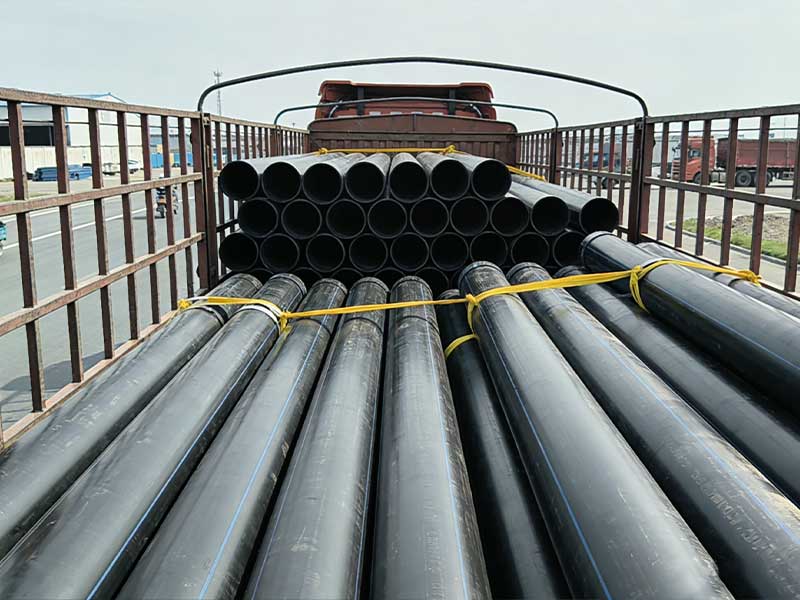
The Manning formula is commonly used to estimate uniform flow in gravity pipes and open channels.
For metric calculations, the basic discharge relationship is:
Q = (1 ÷ n) × A × R^(2/3) × S^(1/2)
Where:
- Q is flow rate in cubic meters per second.
- n is the Manning roughness coefficient.
- A is the flow area in square meters.
- R is the hydraulic radius.
- S is the hydraulic gradient or slope.
Manning Roughness Coefficient
The roughness coefficient represents hydraulic resistance along the internal pipe surface. Smooth-wall polyethylene pipe can use a lower roughness value than many traditional rougher materials.
The Plastics Pipe Institute provides an approximate Manning coefficient of 0.009 for PE in one of its hydraulic design resources. The appropriate design value should still be confirmed against the pipe construction, applicable standard, local authority criteria, and project engineer’s requirements.
Avoid Using Roughness as a Marketing Number
A low laboratory roughness value does not eliminate losses caused by:
- Misaligned fittings
- Poorly formed joints
- Deposits
- Sediment
- Service connections
- Bends
- Manholes
- Changes in pipe diameter
- Partial-flow conditions
The design coefficient should reflect the complete system rather than an ideal section of new pipe.
Illustrative Full-Flow Capacity Comparison
The following table is a preliminary comparison, not a final sewer design. It assumes:
- Solid-wall HDPE pipe
- SDR 17
- Manning n = 0.009
- Full circular flow
- Uniform slope of 0.5%
- No additional losses from fittings, manholes, entrances, or deposits
| Outside diameter | Approximate inside diameter | Approximate full-flow capacity |
| 200 mm | 176 mm | 24 L/s |
| 250 mm | 221 mm | 44 L/s |
| 315 mm | 278 mm | 81 L/s |
| 400 mm | 353 mm | 152 L/s |
| 500 mm | 441 mm | 276 L/s |
The table demonstrates how rapidly theoretical capacity increases with internal diameter. It should not be used as a purchase schedule without checking actual pipe dimensions, partial flow, minimum velocity, local minimum diameter, design flow, structural performance, and safety factors.
Why Slope Changes Capacity
A steeper slope generally increases velocity and gravity-flow capacity. However, steeper is not automatically better.
Excessive velocity can increase abrasion, create difficult transitions, and produce hydraulic problems at manholes or downstream structures. A very shallow slope can reduce velocity and allow solids to settle.
The selected slope must provide a practical balance between capacity, low-flow performance, excavation depth, terrain, and downstream conditions.
HDPE Sewer Pipe Diameter Comparison by Application
There is no universal diameter suitable for every sewer project. The following comparison shows how project conditions influence the selection process.
| Application | Main sizing concern | Typical design approach |
| Building connection | Fixture discharge and local plumbing code | Confirm peak building flow and minimum permitted diameter |
| Residential branch sewer | Peak household flow and solids transport | Check low-flow velocity and future connections |
| Commercial sewer | Short-duration peak discharge | Review operating schedules and simultaneous discharge |
| Industrial wastewater line | Flow, chemicals, temperature and solids | Confirm material compatibility and process peaks |
| Municipal collector | Combined branch flows and future development | Model peak flow, infiltration and staged growth |
| Main interceptor | Large catchment and surcharge risk | Use network-level hydraulic modeling |
| Pumped sewer | Pump duty and pressure loss | Calculate total dynamic head and surge |
| Highway drainage line | Runoff rather than sanitary flow | Use stormwater hydrology and hydraulic criteria |
A small nominal diameter may be sufficient hydraulically but rejected because of local maintenance or minimum-size rules. A larger pipe may satisfy peak capacity but perform poorly at low flow if the grade is too shallow.
Flow Velocity and Self-Cleansing Performance
Capacity is only one part of HDPE sewer pipe sizing. A sewer must also carry suspended and settleable solids through the system.
Low-Flow Velocity
During low-demand periods, wastewater depth and velocity decrease. If the pipe is too large, solids may settle even though the pipe has more than enough peak capacity.
This is one reason unnecessary oversizing can create operational problems rather than solve them.
Self-Cleansing Concept
Self-cleansing describes a flow condition capable of limiting persistent solids deposition. It does not mean the pipe will never require inspection or cleaning.
The required velocity or shear stress depends on:
- Solids characteristics
- Pipe slope
- Flow depth
- Wastewater composition
- Frequency of peak flow
- Local design criteria
Minimum Velocity Is Not Universal
Different authorities may specify different minimum velocity, depth, or shear-stress criteria. The final design should use the requirements accepted by the project owner and local wastewater authority.
Maximum Velocity
High velocities should also be checked. Excessive flow speed may increase abrasion, disturb manhole channels, create turbulence, and cause difficult transitions at changes in grade.
Industrial wastewater containing sand, grit, mineral particles, or process solids requires additional abrasion analysis.
Choosing SDR, Ring Stiffness, and Pipe Structure
Not every HDPE sewer pipe is described in the same way. Solid-wall pressure-capable pipe and structured-wall gravity pipe may use different specification systems.
Solid-Wall HDPE Pipe
Solid-wall pipe is commonly identified by:
- Outside diameter
- Wall thickness
- SDR
- Material grade
- Pressure rating
- Product standard
It may be used for pressure wastewater systems, fused sewer mains, trenchless installations, and selected gravity applications.
Structured-Wall HDPE Pipe
Corrugated or profile-wall drainage pipe may be specified using:
- Nominal diameter
- Inside or outside diameter series
- Ring stiffness
- Pipe stiffness
- Wall profile
- Joint type
- Burial and deflection criteria
SDR and SN Are Not Interchangeable
SDR mainly describes the dimensional relationship of a solid-wall pipe. SN or ring stiffness describes resistance to ring deformation under an external load test.
A buyer should not substitute an SDR value for a required stiffness class or assume that all products with the same nominal diameter have the same structural behavior.
Structural Selection Questions
Before confirming an HDPE sewer pipe, check:
- Is the pipe solid wall or structured wall?
- Is the dimension based on inside or outside diameter?
- What is the actual minimum inside diameter?
- What stiffness or SDR is required?
- What is the burial depth?
- What soil and traffic loads apply?
- What bedding and backfill will be used?
- Is groundwater present?
- Is flotation restraint required?
The Plastics Pipe Institute’s Handbook of Polyethylene Pipe provides broader engineering information on PE materials, design, installation, and applications.
HDPE Sewer Pipe vs PVC and Concrete Pipe
Material comparison should consider more than initial diameter. Joint behavior, installation method, corrosion exposure, structural design, and maintenance access also affect long-term performance.
| Factor | HDPE sewer pipe | PVC sewer pipe | Concrete sewer pipe |
| Corrosion resistance | High | High | Depends on wastewater and protection |
| Joint system | Butt fusion, electrofusion or mechanical | Gasketed or solvent systems depending on product | Usually gasketed joints |
| Flexibility | High | Moderate | Low |
| Weight | Relatively light | Light | Heavy |
| Long continuous runs | Possible with fused sections | Limited by supplied lengths and joint system | Limited by precast section length |
| Trenchless suitability | Strong for many methods | Application-dependent | Limited in many trenchless applications |
| Chemical resistance | Broad, subject to compatibility check | Broad, subject to compatibility check | May require protection in aggressive sewage |
| Structural behavior | Flexible pipe-soil system | Flexible pipe-soil system | Rigid pipe behavior |
| Installation sensitivity | Fusion quality and backfill control | Joint alignment and backfill control | Lifting, bedding and joint alignment |
| Common sizing risk | Ignoring reduced ID from wall thickness | Assuming nominal size equals exact ID | Ignoring roughness and joint condition |
HDPE can be attractive where ground movement, corrosion, trenchless installation, or watertight fusion is important. PVC may be practical for conventional gravity installations, while concrete remains common in large-diameter systems where rigid-pipe design and local supply are established.
The best choice depends on the actual project rather than a single material advantage.
Fittings, Manholes, and Connection Methods
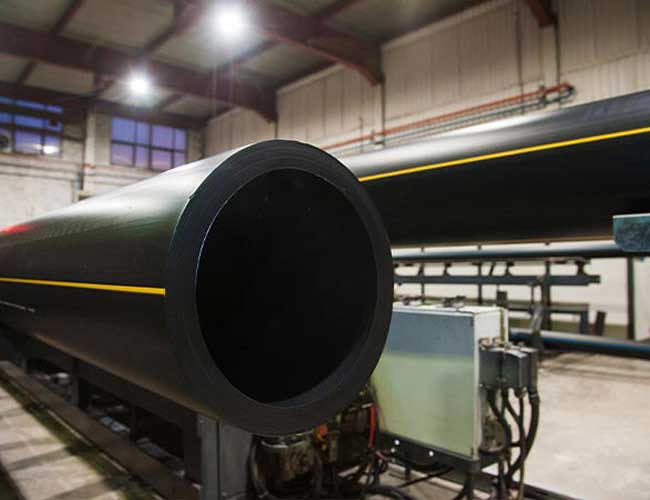
A correctly sized pipe can still underperform if the connection system is poorly planned.
Butt Fusion
Butt fusion joins prepared HDPE pipe ends by heating and pressing them together under controlled conditions. It is commonly used for straight pipe runs and larger-diameter installations.
The process requires appropriate equipment, alignment, temperature control, pressure control, and trained operators.
Electrofusion
Electrofusion fittings contain electrical heating elements that fuse the fitting to the pipe surface. They are useful for repairs, restricted workspaces, branches, and locations where butt-fusion equipment is difficult to position.
Zenlink’s electrofusion pipe fittings are intended for secure polyethylene pipeline connections, while its HDPE pipe fittings include elbows, tees, reducers, end caps, and flange adapters for wastewater and other piping systems.
Manholes and Inspection Structures
Manholes provide access for inspection, cleaning, changes in direction, grade transitions, and network connections.
Their hydraulic effects should be included where relevant. Poor benching, sharp changes in direction, offset inverts, or badly formed channels can create turbulence and solids accumulation.
Connection Compatibility
Pipe, fittings, manhole connectors, reducers, fusion equipment, and transition components must match the actual outside diameter and product system. Similar nominal descriptions do not guarantee compatibility.
Burial Depth and Installation Conditions
Hydraulic capacity cannot be separated from structural performance. A buried HDPE sewer pipe works with the surrounding soil to resist external loads.
Bedding
Bedding provides uniform support beneath the pipe. Poor bedding can create point loading, uneven settlement, deformation, or loss of grade.
The material, thickness, compaction, and shaping should follow the specified installation standard.
Sidefill and Backfill
Compacted soil at the sides of a flexible pipe provides essential structural support. Improper sidefill can lead to excessive deflection even when the pipe material itself meets the required specification.
Haunch Compaction
The haunch area below the pipe’s springline is particularly important. Material must be placed and compacted without leaving unsupported voids.
Traffic and Surface Loads
Roadways, industrial yards, ports, and construction zones may apply substantial live loads. The design should evaluate:
- Cover depth
- Vehicle loading
- Soil stiffness
- Pipe stiffness
- Trench width
- Groundwater
- Installation quality
Flotation
An empty or partially full HDPE sewer pipe can become buoyant when groundwater rises. Flotation risk should be evaluated for shallow installations, wet ground, river crossings, and construction before final backfilling.
Deflection
Flexible pipes normally experience limited deformation as the pipe-soil system develops. Excessive deflection can reduce the inside diameter, affect joints, change the flow line, and complicate inspection.
Post-installation inspection may include deflection testing, line-and-grade verification, leakage testing, or CCTV inspection according to project requirements.
A Step-by-Step HDPE Sewer Pipe Sizing Process
Step 1: Define the Wastewater Source
Identify whether the pipe will serve residential sewage, commercial wastewater, industrial effluent, storm drainage, combined flow, or a pumped system.
Wastewater temperature, chemicals, grit, grease, fibers, and solids should be documented.
Step 2: Calculate Average and Peak Flow
Estimate present average flow, peak flow, infiltration, inflow, process discharge, and future development.
Use recorded data where available rather than relying entirely on generalized assumptions.
Step 3: Confirm Gravity or Pressure Operation
For gravity flow, establish available slope, invert elevations, downstream water level, and surcharge limits.
For pressure flow, confirm pump curve, static lift, total head, surge conditions, and operating sequence.
Step 4: Select a Preliminary Inside Diameter
Use the applicable hydraulic method to identify a diameter that can carry the design flow.
Check both peak-flow capacity and low-flow performance.
Step 5: Convert Inside Diameter to a Product Size
Compare the required hydraulic opening with available outside diameters, SDR values, wall thicknesses, or structured-wall dimensions.
Do not select only by nominal diameter.
Step 6: Add Minor and System Losses
Review bends, tees, reducers, valves, transitions, manholes, entrances, exits, service connections, and irregular flow conditions.
For pressure systems, include these losses in the total dynamic head calculation.
Step 7: Complete Structural Design
Check burial depth, soil, groundwater, surface load, trench width, pipe stiffness, deflection, buckling, and flotation.
Step 8: Select Compatible Fittings
Confirm fitting diameter, SDR or pressure class, fusion method, manhole connection, flange system, and transition requirements.
Step 9: Verify Applicable Standards
Check the required product, design, installation, testing, and inspection standards for the project location.
Step 10: Review the Complete Network
A pipe section should not be selected in isolation. Confirm that downstream pipes, lift stations, manholes, treatment facilities, and discharge structures can accept the planned flow.
Common HDPE Sewer Pipe Sizing Mistakes
Selecting by Outside Diameter Alone
Outside diameter does not show the actual internal opening. Wall thickness or pipe profile must also be checked.
Using Average Flow as Design Flow
Average wastewater production can significantly underestimate short-duration peaks and additional wet-weather flow.
Oversizing for Safety
A larger pipe may appear safer, but it can reduce low-flow depth and velocity. This may increase sediment deposition and maintenance requirements.
Ignoring Future Connections
A pipe sized without a documented development plan may require early replacement or parallel capacity.
Applying Pressure-Pipe SDR Logic to Every Sewer
Some gravity sewer products are specified by stiffness or profile design rather than pressure-based SDR alone.
Forgetting Fittings and Structures
The capacity of a straight pipe does not represent the performance of a network containing bends, junctions, manholes, reducers, and transitions.
Ignoring Groundwater
Groundwater can affect infiltration, trench stability, external pressure, and flotation.
Mixing Incompatible Components
Pipes and fittings with similar nominal descriptions may use different actual dimensions or connection systems.
Treating an Online Table as Final Engineering
Online sizing charts are useful for preliminary comparison. They cannot replace project-specific flow calculations, local regulations, structural design, or professional review.
HDPE Sewer Pipe Solutions for Municipal and Industrial Projects
Zenlink provides plastic pipe and fitting options for municipal engineering, industrial wastewater discharge, underground infrastructure, and drainage systems.
The company’s municipal engineering solutions include HDPE pipes, fittings, fusion connection options, and pipeline-selection information for water and drainage-related infrastructure. The page also discusses butt fusion, electrofusion, large-diameter applications, and municipal pipeline planning.
For buyers comparing material terminology, standards, and applications, the article What Is PE Piping? provides additional background on polyethylene pipe classifications, engineering properties, installation risks, and lifecycle considerations.
A useful technical inquiry should include:
- Wastewater type
- Required flow rate
- Gravity or pressure operation
- Outside or inside diameter requirement
- SDR, wall thickness, or stiffness class
- Pipe length and quantity
- Burial depth
- Soil and groundwater conditions
- Required fittings
- Connection method
- Applicable product standard
- Project location
- Inspection and documentation requirements
Providing this information helps the supplier recommend a more complete pipe-and-fitting system instead of quoting an isolated nominal diameter.
Conclusion
A reliable HDPE sewer pipe design begins with flow conditions and ends with verification of the complete installed system.
The most important sizing factors are:
- Peak and low-flow conditions
- Actual inside diameter
- Pipe slope
- Hydraulic roughness
- SDR or stiffness class
- Wastewater characteristics
- Fittings and manholes
- Burial and soil conditions
- Groundwater and flotation
- Future development
- Local standards
The smallest pipe is not always the most economical, and the largest pipe is not always the safest. The correct choice is the pipe that provides adequate peak capacity, acceptable low-flow performance, structural stability, compatible connections, and practical maintenance throughout the intended service life.
Project planners can review Zenlink’s plastic pipe products, HDPE pipe fittings, and municipal pipeline solutions when developing a complete wastewater or drainage system.
FAQ
What size HDPE sewer pipe do I actually need?
The required size depends on peak wastewater flow, slope, pipe inside diameter, roughness, solids, infiltration, future growth, and local minimum-size requirements. A hydraulic calculation should be completed before the product diameter is confirmed.
Is a 200 mm HDPE sewer pipe large enough for a municipal sewer?
It may be suitable for some branch sewers, but diameter alone cannot answer the question. Designers must compare the actual inside diameter and slope with peak flow, low-flow conditions, future connections, and local municipal criteria.
Is HDPE sewer pipe measured by inside or outside diameter?
Many solid-wall HDPE products are identified by outside diameter. The inside diameter depends on wall thickness and SDR. Structured-wall products may follow a different diameter series, so the manufacturer’s dimensional table should always be checked.
Does a lower SDR give an HDPE sewer pipe more flow?
No. A lower SDR means a thicker wall for the same outside diameter, which normally reduces the inside diameter and available flow area. It may provide greater pressure capacity, but it does not automatically increase hydraulic capacity.
Can I use the Manning equation to size every sewer pipe?
The Manning equation is commonly used for gravity-flow analysis. Pumped or pressure sewers usually require pressure-loss calculations, pump analysis, and surge checks. Complex gravity networks may also require hydraulic modeling.
What slope should I use for an HDPE gravity sewer?
The slope must provide sufficient capacity and acceptable solids transport without creating excessive velocity or excavation depth. The exact minimum slope depends on diameter, design flow, local regulations, and project conditions.
Is a bigger HDPE sewer pipe always better?
No. An unnecessarily large pipe can produce shallow low-flow conditions and reduced velocity, which may encourage solids deposition. It also increases fitting, transportation, excavation, and installation requirements.
How do I compare SDR 11 and SDR 17 sewer pipe?
Compare wall thickness, actual inside diameter, pressure capacity, structural requirements, available fittings, and intended operating condition. SDR 11 has a thicker wall, while SDR 17 generally provides a larger inside diameter at the same outside diameter.
Can HDPE sewer pipe be connected directly to a concrete manhole?
Yes, but a compatible manhole connector, boot, adapter, or engineered transition is normally required. The connection must accommodate movement, maintain sealing, and match the actual outside diameter.
Are electrofusion fittings suitable for wastewater systems?
Yes, provided the fittings are compatible with the pipe material, diameter, SDR, pressure condition, and wastewater environment. Electrofusion is particularly useful for repairs, branches, restricted spaces, and complex connection points.
What information should I send when requesting an HDPE sewer pipe quotation?
Provide the application, flow rate, diameter, SDR or stiffness class, pipe length, quantity, burial depth, operating pressure, wastewater type, fittings, connection method, applicable standard, project location, and documentation requirements.
Do I need an engineer to select HDPE sewer pipe size?
Municipal, industrial, deep-burial, pressure, high-flow, and regulated sewer systems should be reviewed by a qualified engineer. Supplier recommendations and online tables can support preliminary selection but should not replace final hydraulic and structural design.